








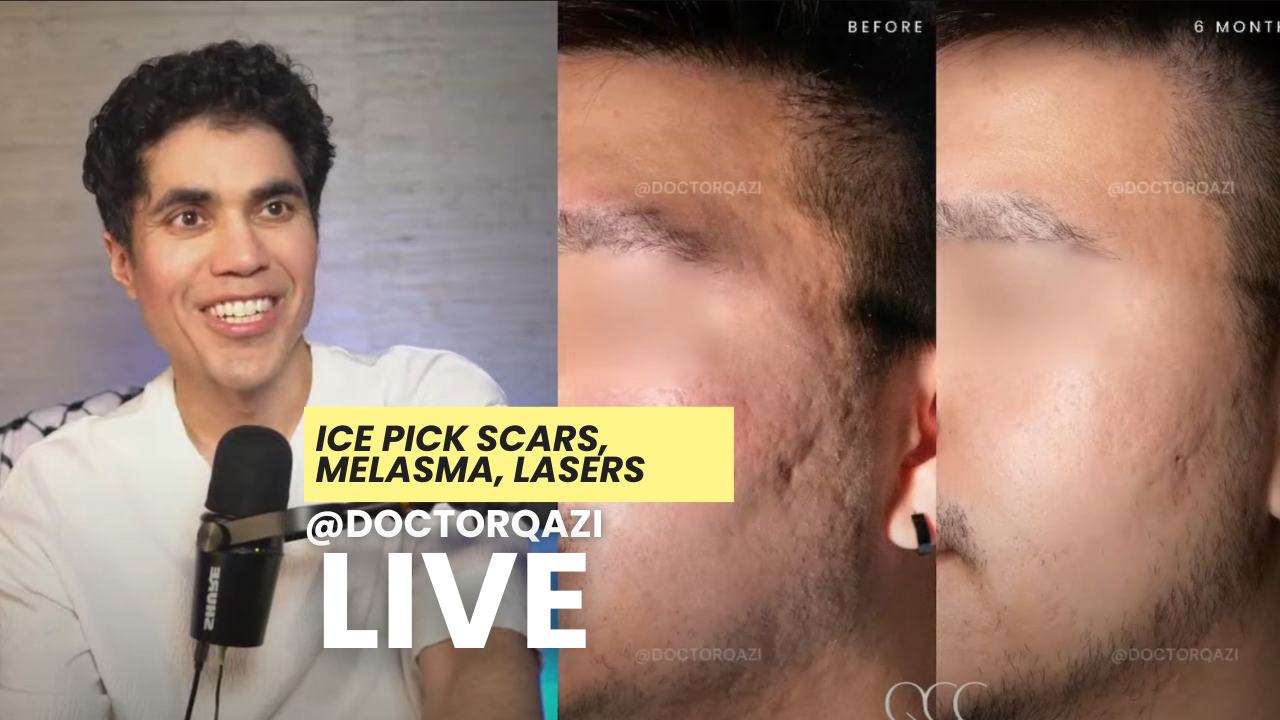
I’m Dr. Qazi, a skin restoration specialist based in Newport Beach, California. My practice focuses primarily on treating acne, scars, pigmentation issues, and facial balancing. Today, I want to walk you through a recent case that showcases how we approach scar treatment for patients of Asian descent in their 30s. This particular patient has deep scars, including ice pick scars, and was concerned about pigmentation changes. I will also talk about other topics such as how to treat ice pick scars, melasma, ablative lasers, and more. Together, we worked on achieving optimal results while ensuring his skin tone remained balanced and healthy.
The Patient’s Concerns and Initial Assessment
This patient came to me with several concerns. He had significant scarring, particularly on the lateral cheek area, where there was a deep indentation. These scars were not only affecting his appearance but also impacting his confidence. As someone in his 30s, he wanted a solution that would help him feel comfortable in his skin again. Beyond the scarring, he expressed concern about maintaining normal pigmentation during and after treatment.
After assessing his skin, I determined that a combination of treatments would be most effective. His Fitzpatrick skin type (a scale used to classify skin color) is Type 4, which means he has a higher risk of hyperpigmentation if certain procedures are not done carefully. For this reason, I knew we needed to proceed strategically.
Breaking Down the Treatment Plan
Step 1: Subcision to Release Scar Tissue
The first step in our treatment plan was subcision , a procedure designed to break up scar tissue beneath the skin’s surface. In this patient’s case, the scars were tethered down tightly, creating those deep indentations. To address this, I used a specialized tool called the Taylor Liberator . This device allows me to meticulously target and release interdermal scar tissue without causing unnecessary trauma to the surrounding skin.
Subcision works by severing the fibrous bands that pull the skin downward, allowing the scarred areas to lift and heal more evenly. For this patient, it was crucial to focus on the areas where the scars were most prominent. After breaking up the scar tissue, I could already see an improvement in the texture and depth of his scars.
Step 2: Ablative Lasers for Smoothing and Blending
Once the subcision was complete, we moved on to laser treatments. I combined two types of lasers—CO2 and erbium —to achieve the best results. The CO2 laser is highly effective for targeting thick, stubborn scars, while the erbium laser helps blend the treated areas with the surrounding skin, reducing the risk of noticeable demarcation lines.
For this patient, I used the fully ablative CO2 laser on the thicker scars to smooth out their edges and create a more uniform appearance. The erbium laser was then applied to the surrounding areas to ensure a seamless transition between treated and untreated skin. This combination approach is one of the reasons why my patients see such transformative results.
Step 3: TCA Cross for Ice Pick Scars
Ice pick scars can be particularly challenging to treat because of their narrow, deep nature. For these types of scars, I rely heavily on a technique called TCA Cross . This involves applying a high concentration of trichloroacetic acid (TCA) directly into the base of the scar. The acid destroys the scar tissue and promotes collagen production, effectively filling in the scar from within.
In this patient’s case, we performed multiple rounds of TCA Cross over several months. Each session brought us closer to our goal of lifting and smoothing the scars. The results were remarkable—his ice pick scars became significantly less noticeable, and the overall texture of his skin improved dramatically.
Step 4: Skin Tightening with FaceTite and Morpheus8
Beyond addressing the scars, this patient also wanted to tighten the skin along his jawline and neck. To achieve this, we incorporated FaceTite and Morpheus8 , two advanced technologies that use radiofrequency energy to stimulate collagen production and tighten loose skin. These treatments complemented the scar revision process beautifully, giving him a more youthful and defined profile.
Addressing Pigmentation Concerns
One of the biggest fears for patients with darker skin tones is developing post-inflammatory hyperpigmentation (PIH) or other forms of discoloration after treatment. To mitigate this risk, I always emphasize proper pre- and post-treatment care. This includes prescribing topical creams tailored to the patient’s specific needs and advising them on sun protection strategies.
For this patient, we used a combination of topical retinoids and pigmentation creams to maintain an even skin tone throughout the healing process. Additionally, I recommended wearing a wide-brimmed visor whenever he was outdoors—a trick I personally use to protect my own fair skin!
The Results Speak for Themselves
Six months after the initial treatment, the patient returned for a follow-up session. By this point, his scars had lifted significantly, and his skin tone looked healthier and more balanced. We performed a second round of CO2 laser and TCA Cross to refine the results further. Even though it’s only been a few weeks since his last visit, I’m confident that his skin will continue to improve as collagen production peaks over the next several months.
Common Questions About Scar Treatment
Over the years, I’ve encountered countless questions about scar treatment, and I’d like to address a few of them here:
1. Can Bellafill Be Used for Acne Scars?
Yes, Bellafill can be an excellent option for certain types of scars, especially boxcar scars. However, it’s essential to break up the scar tissue first using subcision before injecting any filler. This ensures that the product is placed in the correct pocket and provides long-lasting support for the scarred area. That said, not every patient requires Bellafill. In this particular case, we achieved fantastic results without needing volume replacement.
2. Does Anesthesia Affect Collagen Production?
There’s a misconception floating around that anesthesia or numbing agents like lidocaine can interfere with collagen production. Let me clear this up once and for all: there is no evidence to support this claim. Lidocaine, epinephrine, and saline—the components of tumescent fluid—are metabolized quickly by the body and do not have long-term effects on collagen synthesis. Performing subcision without anesthesia is not only cruel but also unnecessary.
3. What Causes Acne Scars?
Acne scars form due to a combination of genetic predisposition and inflammatory responses. When your body attacks a cystic lesion, it releases enzymes and inflammatory mediators that destroy healthy tissue in the process. Over time, this leads to atrophic scars. Some individuals may also develop hypertrophic scars due to excessive tension or friction in the affected area.
4. How Long Should You Wait Between Treatments?
The timing between sessions depends on the type of treatment and how your skin responds. For example, if you’re undergoing microneedling or laser therapy, I typically recommend waiting 4–6 weeks between sessions. This allows enough time for your skin to heal and begin producing new collagen.
Final Thoughts
Treating acne scars and pigmentation issues requires a personalized approach. Every patient is unique, and what works for one person may not work for another. That’s why I take the time to assess each individual’s needs and tailor my treatments accordingly. Whether it’s through subcision, lasers, or skin tightening, my goal is always the same: to help my patients regain their confidence and enjoy smoother, healthier-looking skin.
Thank you for joining me today! If you have any questions or would like to learn more about my practice, feel free to reach out to 949-336-7293 or visit doctorqazi.com to self-schedule a consultation with me. I’m here to help you on your journey to better skin.

Meet Dr. Nadir Qazi
While growing up in Chicago, I struggled for years with severe acne and scarring. Dealing with constant comments about my skin, especially from friends and family, wasn’t easy. That feeling of isolation and defeat hit me hard. Many around me were in the same position, yet there were very limited solutions available. This led me to determine my mission: to tirelessly build a unique medical practice where compassion meets science, providing proper care for every overlooked skin type and tone. At my Center, my team and I offer only clinically proven treatments that I have personally researched. My goal is to help others achieve their dreams, breaking free from the constraints of their physical appearance, and to be the support I needed the most.



