








When you’re a teenager and your face is erupting with zits, you probably didn’t stop to ask yourself, “Will popping this pimple cause me to find an acne scar specialist in 5 or 10 years?” Or “Will I eventually need “acne scar treatment?” Or “Will I have embarrassing scars from my skin condition for the rest of my life?”
What Are Acne Scars, Exactly?
The U.S. National Library of Medicine, National Institute of Health says…
“Acne has a prevalence of over 90% among adolescents and persists into adulthood in approximately 12% to 14% of cases with psychological and social implications.
Possible outcomes of the inflammatory acne lesions are acne scars which, although they can be treated in a number of ways, may have a negative psychological impact on social life and relationships.”
What Are The Types of Acne Scars?
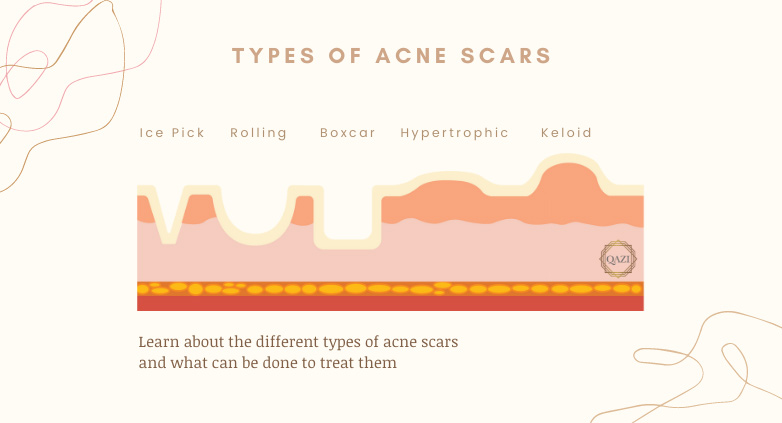
The main types of acne scars are atrophic (or depressed scarring) and hypertrophic (or keloid scarring), though some people can have all three types of atrophic scars.
- One type of atrophic scarring is known as “icepick” scars, because they’re narrow, deep sharp, and extend vertically into your skin. They typically represent about 60% to 70% of all acne scars.
- Second, “boxcar” scars comprise 20% to 30% of all acne scars. They are round to oval with sharply vertical edges, can be deep or shallow, are clinically wider than icepick scars, and can be visualized with a “U” shape.
- Third, “rolling” scars account for another 15% to 25% of atrophic scars. These types of scars occur from dermal tethering, which means they are connected to the lower skin layers, and have an undulating appearance on your skin with an “M” shape. They are usually wider than 4 to 5 mm.
- Finally, there are hypertrophic scars, which are typically pink, raised and firm; while keloids are reddish-purpose papules. Both are most common in people with darker skin.
Why Would I Need an Acne Scar Treatment?
According to the American Society for Dermatologic Surgery, “acne scars are usually the result of inflamed blemishes by skin pores engorged with excess oil, dead skin cells, and bacteria. The pore swells, causing a break in the follicle wall. Shallow lesions are usually minor and heal quickly. But if there is a deep break in the wall of the pore, infected material can spill out into the surrounding tissue, creating deeper lesions. The skin attempts to repair these lesions by forming new collagen fibers. These repairs usually aren’t as smooth and flawless as the original skin.”
So when your skin is left with an uneven texture, is marked by various, and is no longer smooth, you may need to seek the help of an acne scar specialist.
At Qazi Cosmetic Center and Med Spa, Dr. Nadir Qazi is an expert in removing imperfections in your skin from acne scarring. For these problems, he offers medical grade chemical peels, luxurious facials, laser treatments, radiofrequency microneedling for your face and body, or a combination of these procedures for atrophic scars.
Can Chemical Peels and Facials Help Acne Scars?
The short answer is “Yes!” Dr. Qazi treats the following types of acne to provide your skin with its normal glow:
- Keloid scars
- Active acne outbreaks
- Aging skin
- Cystic pimples
- Fine lines
- Ingrown hairs
- Large pores
- Rosacea
- And sun damage
Chemical Peels Like No Other
For each of these unfortunate skin conditions, we recommend a combination of skin-soothing, skin-repairing treatments.
A medical grade chemical peel is applied by Dr. Qazi to meet your skin’s personalized needs. By the way, because of his years of physician training, this level of chemical peel treats the skin and prepares it for energy devices, so it is much more effective than a peel performed by a nurse or an esthetician.
This chemical peel penetrates into your skin to help fade mild acne scars, as well as melasma, sun damage, discoloration, fine lines, and wrinkles. It’s actually our most popular peel, safe for all skin types, and has minimal downtime. Optimal results usually require a few sessions.
Another option for a chemical peel for acne scars is TCA CROSS. TCA is an abbreviation for “trichloroacetic acid”, while CROSS is an acronym for “chemical reconstruction of skin scars”. This is a safe, cost-effective, and minimally invasive procedure for ice pick acne scars using a chemical mixture of a variety of strengths to clear away dead skin cells to stimulate newer, smoother skin growth below.
Subcision Treatments for Acne Scars
A simple, safe, in-office procedure for treatment of depressed acne scars and wrinkles is called subcision, medically known as “subcutaneous incisionless surgery”.
Performed under local anesthesia with a special hypodermic needle inserted through the skin’s surface, the sharp edges of the needle break fibrotic strands in the underlying scar tissue.
Subcision can provide significant long-term improvement to acne scars and can also be combined with other treatments at Qazi Clinic.
Our Newest Laser Treatment Also Removes Acne Scars
There are a few other possible treatments available at Qazi Clinic, and our latest is our Eraser Laser Treatment to literally zap away your active acne or acne scars on your cheeks or forehead, but without any pain.
This treatment may require several to as many as six sessions to obtain their optimal results, but many patients are noticing a 20% improvement after their first laser session.
Microneedling For Maximum Results
Radiofrequency (RF) Microneedling is a safe, minimally invasive procedure that we offer at Qazi Cosmetic Center to deliver heated energy beneath multiple layers of your skin to directly stimulate your own natural collagen (protein) production.
This treatment, with minimal downtime, can be especially helpful for patients of all skin types who have acne scars, visibly large pores, sun damage, dark spots, fine lines, and stretch marks.
What Are The Results of an Acne Scar Treatment?
The results of our treatments by our acne scar specialist include:
- Medical-Grade Chemical Peels can help to fade mild acne scars within a week. But with customized treatments, they can also fight active acne and reduce future flare ups. Any redness and flaking should stop after about 7 days to reveal new, healthy-looking skin.
- And RF Microneedling can reduce acne scars, shrink larger pores, repair sun damage, dissipate dark spots, smooth fine lines, and minimize stretch marks. This particular treatment can show immediate results for some patients, but new collagen typically can take about three months to build, and results should last approximately three to six months.
Who Is A Good Candidate For Any of These Treatments?
Regardless of your age, gender, or skin tone, whether you’re pregnant or not, just about anyone with acne scars, as well as active acne, fine lines, or can benefit from a deep skin cleansing from a chemical peel, or can see good results from Radiofrequency Microneedling.
As with any of our cosmetic treatments, an initial consultation with Dr. Qazi will determine which particular treatment or combination will work best for your skin.
Are Any of These Procedures Painful?
Our medical-grade chemical peels are virtually painless; you may only feel a tingling sensation during the procedure. Patients report that our facials feel like a cooling massage and are very receptive.
Our RF Microneedling treatment by an acne scar specialist is typically quite comfortable. We provide a topical medical-grade numbing medication before starting this procedure, which most patients describe as feeling a light pressure with an occasional spark feeling.
What Should You Do Prior to Your Appointment?
As with other facial treatments, we recommend that our patients avoid wearing makeup on the day of your procedure, but our office specialists can also remove any make-up if you wish.
If you have been taking Accutane to treat acne within the last three months, or if you’re having an active herpes outbreak, you should avoid any chemical peels.
For any acne scar treatment, including RF Microneedling, you should not wax, shave, or thread your face on the day of your procedure.
Should you have any concerns, please discuss them with Dr. Qazi during your first office visit.
Are There Any Side Effects?
There are typically no side effects for facials, chemical peels or microneedling. However, you may experience the following temporary reactions:
- Redness and irritation
- Blotchy skin
- Post-facial breakouts
- Tenderness
- Scarring
- Tenderness
- Dryness
Are There Any Aftercare Instructions for These Treatments?
Dr. Qazi takes the time to meet with each and every patient to discuss your individual treatment options –– before, during, and especially after a procedure.
There are no aftercare instructions, but we would not recommend going into a steam or sauna after the procedure, and would also recommend avoiding facials or waxing the treated area the same day. It is also essential to wear sunscreen diligently after your treatment.
Are These Treatments Safe For My Skin Tone?
Yes, patients with any skin tone as well as any type of skin can all benefit from these types of treatments, customized and safe for you.
What Does A Scarring Treatment for Acne Cost?
At Qazi Cosmetic Center and Med Spa, the cost for any non-invasive cosmetic procedure depends on your particular needs and your desired results. This will all be discussed at your initial consultation with Dr. Qazi.
Can I Read Some Testimonials About Scarring Treatments?*
Our first priority with each patient is his or her satisfaction, especially for acne scarring treatments. Here are some recent testimonials about various treatments…
“I got the airbrush facial and highly recommend it! My skin is so smooth and it definitely helped with acne as well. The results are long lasting and I love that the exfoliating process was very gentle. Dr. Qazi’s staff is amazing and very knowledgeable!”
– S.N., Irvine CA

*Results may vary and are not guaranteed.
Book Your Appointment Today for an Acne Scar Treatment.
To learn more about treatments by our expert acne scar specialist, please contact our office to schedule your initial consultation here in Newport Beach, California

Meet Dr. Nadir Qazi
While growing up in Chicago, I struggled for years with severe acne and scarring. Dealing with constant comments about my skin, especially from friends and family, wasn’t easy. That feeling of isolation and defeat hit me hard. Many around me were in the same position, yet there were very limited solutions available. This led me to determine my mission: to tirelessly build a unique medical practice where compassion meets science, providing proper care for every overlooked skin type and tone. At my Center, my team and I offer only clinically proven treatments that I have personally researched. My goal is to help others achieve their dreams, breaking free from the constraints of their physical appearance, and to be the support I needed the most.



