








Acne can be a challenging experience, but what follows can be just as frustrating: the lingering marks left behind. These marks can be either acne scars or hyperpigmentation, and while they might look similar, they are distinct in nature and require different treatments. Understanding the difference between acne scars and hyperpigmentation is crucial for effective treatment. For more information contact Dr. Qazi at Qazi Cosmetic Center, (949)-336-7293.

What Are Acne Scars?
Definition:
Acne scars are the result of inflamed blemishes caused by skin pores engorged with excess oil, dead skin cells, and bacteria. When these pores swell, a break occurs in the follicle wall. Minor lesions produce shallow scars that heal quickly, but if there is a deep break in the wall of the pore, infected material spills out into surrounding tissue, causing deeper scars.
- Types of Acne Scars:
- Hypertrophic Scars: These are raised scars that develop when the skin produces too much collagen as it heals, resulting in a mass of raised tissue on the surface of the skin.
- Atrophic Scars: These are depressed scars that sit below the surrounding skin. They occur when not enough collagen is produced during healing. Subtypes include ice pick, boxcar, and rolling scars.
What Is Hyperpigmentation?
Definition:
Post-inflammatory hyperpigmentation (PIH) occurs when a dark spot forms in place of an acne lesion that has healed. This discoloration is caused by an overproduction of melanin, the pigment that gives your skin its color, in response to inflammation. Unlike acne scars, hyperpigmentation is not a true scar and can fade over time.
Key Characteristics:
- Fading: Over time, hyperpigmentation tends to fade on its own, though it can take months or even years without treatment.
- Color: Typically, hyperpigmentation appears as a flat area of discoloration ranging from pink to red, purple, brown, or black, depending on your skin tone.
The Difference Between Acne Scars and Hyperpigmentation
Understanding the difference between acne scars and hyperpigmentation is vital for choosing the right treatment:
- Treatment: Acne scars often require more intensive treatments like microneedling, laser therapy, or fillers. Hyperpigmentation can often be treated with topical treatments, chemical peels, or laser therapy.
- Formation: Acne scars are a result of damage to the skin’s tissue, leading to permanent changes in the texture of the skin. Hyperpigmentation, however, is simply an increase in pigment production and usually resolves on its own.
- Appearance: Acne scars are usually indented or raised, whereas hyperpigmentation presents as flat spots of discoloration.
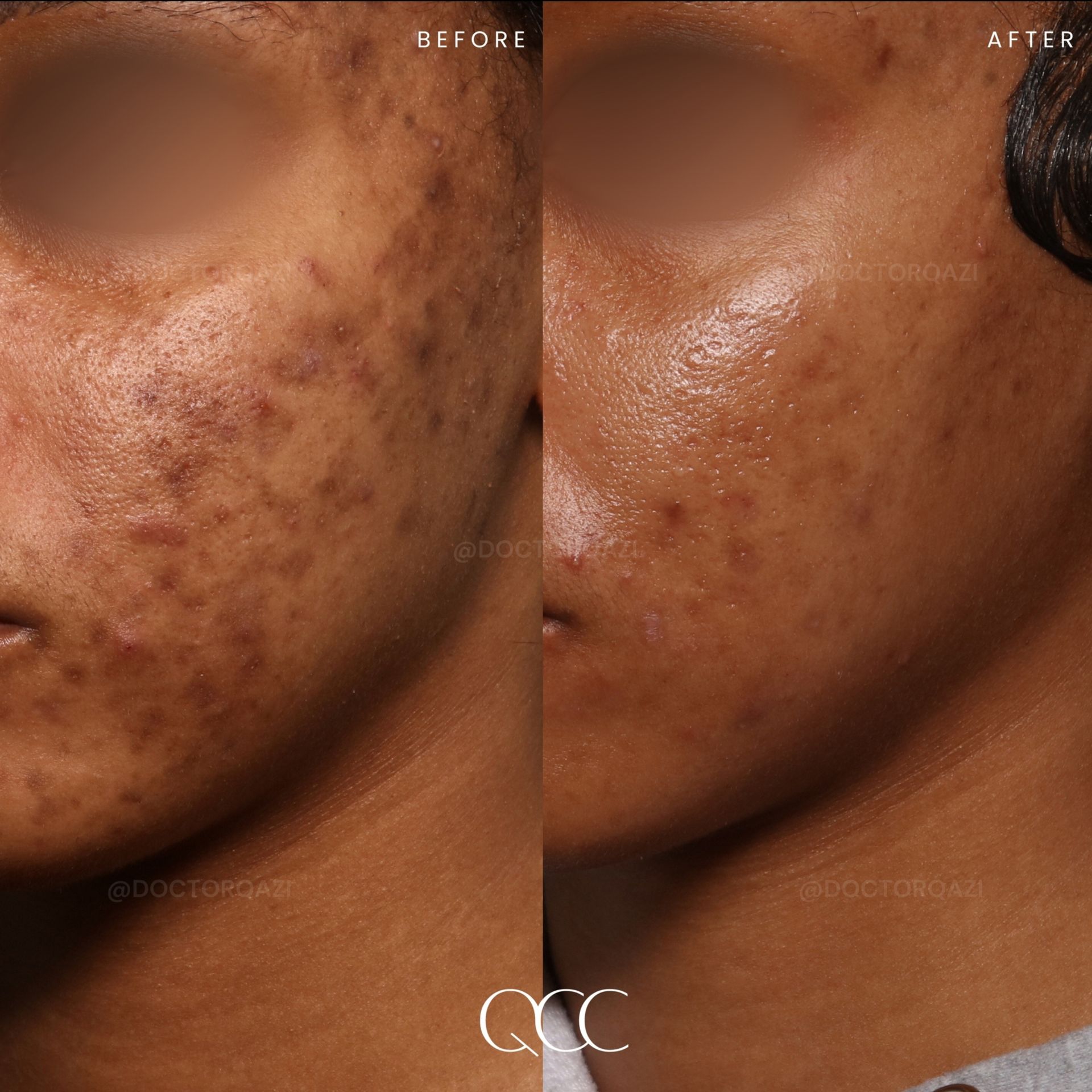
Treatment Options for Acne Scars and Hyperpigmentation in Orange County
At Qazi Cosmetic Center, located in the heart of Orange County, we offer a variety of treatments to address both acne scars and hyperpigmentation. Here’s a breakdown of the available options:
1. Chemical Peels
- How it works: A chemical peel involves applying a solution to the skin that causes it to exfoliate and eventually peel off, revealing new, smoother skin beneath.
- Best for: Hyperpigmentation and mild acne scars.
- Benefits: Evens skin tone, reduces dark spots, and improves skin texture.
2. Laser Therapy
- How it works: Laser treatments use focused light to target the deeper layers of the skin, stimulating collagen production and reducing the appearance of scars and pigmentation.
- Best for: Both acne scars and hyperpigmentation.
- Benefits: Precision treatment with minimal downtime, effective for various skin types.
3. Microneedling
- How it works: Microneedling uses tiny needles to create micro-injuries in the skin, which promotes collagen and elastin production, helping to smooth out acne scars.
- Best for: Depressed acne scars.
- Benefits: Improves skin texture, reduces scar depth, and enhances skin elasticity.
4. Topical Treatments
- How it works: Topical creams and serums that contain ingredients like retinoids, hydroquinone, or vitamin C can help lighten hyperpigmentation and promote cell turnover.
- Best for: Hyperpigmentation.
- Benefits: Non-invasive, easy to incorporate into your skincare routine.
5. Fillers
- Benefits: Immediate results with minimal downtime.
- How it works: Dermal fillers can be injected into the skin to lift and smooth out depressed acne scars.
- Best for: Atrophic scars.
Why Choose Qazi Cosmetic Center for Your Treatment?
- Expert Care:
At Qazi Cosmetic Center, we understand the emotional toll that acne scars and hyperpigmentation can take. Our team is dedicated to providing personalized treatment plans tailored to your specific skin type and concerns. - Advanced Technology:
We utilize the latest technology and techniques to ensure you receive the best possible results with minimal discomfort and downtime. - Customized Solutions:
No two skin types are the same, and neither are our treatments. We offer a variety of options to ensure that your skin receives exactly what it needs.
Contact Qazi Cosmetic Center, Orange County
Understanding the difference between acne scars and hyperpigmentation is the first step toward achieving clearer skin. Whether you’re dealing with stubborn acne scars or persistent hyperpigmentation, the right treatment can make a world of difference. Contact us today at (949)-336-7293 to schedule a consultation and more information.

Meet Dr. Nadir Qazi
While growing up in Chicago, I struggled for years with severe acne and scarring. Dealing with constant comments about my skin, especially from friends and family, wasn’t easy. That feeling of isolation and defeat hit me hard. Many around me were in the same position, yet there were very limited solutions available. This led me to determine my mission: to tirelessly build a unique medical practice where compassion meets science, providing proper care for every overlooked skin type and tone. At my Center, my team and I offer only clinically proven treatments that I have personally researched. My goal is to help others achieve their dreams, breaking free from the constraints of their physical appearance, and to be the support I needed the most.



