








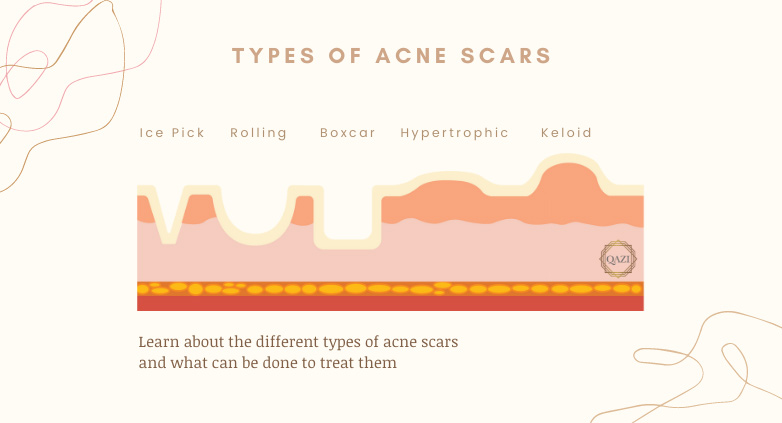
Acne is bad enough as it is. Just when you think you are done and can stop covering the pimple with makeup, you get acne scars. But don’t worry! Acne scars can be easily and effectively treated at a cosmetic practice and medspa like Qazi Cosmetic Center. The trick to treating acne scars is understanding the types of acne scars.
What are the 5 types of acne scars?
- Boxcar Scars
- Icepick Scars
- Rolling Scars
- Hypertrophic Scars
- Keloid Scars
What Causes Different Types of Acne Scars To Form?
Not all acne turns into a scar. Whether your acne scars over depends on how much collagen your body produces in response to damaged skin. Acne itself occurs when pores become clogged with excess oil, bacteria, and dead skin cells. When the pore swells or the pimple gets popped, this causes a break in the follicle wall, which spills the bacteria and oil into other skin cells.
The result is inflammation and damage to your skin.
Acne scars have to do with how the body tries to repair itself after skin cells have been damaged. Collagen is a substance in the skin that provides support and elasticity. If your body produces too much collagen when the acne heals over, it results in protruding acne scars, namely hypertrophic and keloid scars. If your body produces too little collagen, the result is a small indent in the skin, which is referred to as atrophic scarring.
Boxcar, icepick, and rolling scars represent this type of acne scar.
1. Boxcar Acne Scars – Causes & Treatments
Boxcar scars are a type of atrophic scar because they are broad depressions in the skin that usually appear box-like in shape. This type can be distinguished from other types of acne scars because the edges are normally sharply defined. Because they are indented, boxcar scars are most often found on the lower cheeks and jaw where the skin is relatively thick.
Boxcar scars are most often the result of inflammatory acne, including irritated papules and pustules. However, chickenpox and viruses that cause rashes and blisters have also been known to result in this type of scaring. When the skin is damaged by inflammatory acne or blisters, some tissue is lost and the skin is left with reduced support. Additionally, if your skin produces too little collagen to heal properly, the indents remain.
Treatments:
- Laser Treatment – The problem with boxcar scars is not enough collagen, therefore the solution is more collagen! Laser treatments use heat to remove the topmost layer of your skin where the scar is most visible. The heat and light from the laser also draws blood to the area to reduce inflammation and boosts your natural collagen production.
While this treatment doesn’t completely remove acne scars, it can greatly improve your appearance by minimizing them. Laser treatment is ideal for people with busy lives because there is minimal downtime and your results will begin to show 24 to 72 hours after the treatment.
Please note that if you have serious, active acne, a darker skin tone, or heavily wrinkled skin, then certain laser treatments may not be right for you.
- Fillers – These are FDA-approved, skin-safe injections that are used to provide volume under the skin. One popular use for fillers is to balance the face, lessen under eye circles, and create contour. However, they can also be used to improve some types of acne scars, including boxcar scars.
Fillers work well for atrophic scars because they fill in the volume that was lost when that area of the skin was damaged. Fillers are primarily made up of hyaluronic acid, which has the added benefit of increasing collagen production over time to smooth over your acne scars. Dr. Qazi can also use collagen stimulators such as Radiesse or Sculptra to help repair the skin over time. For immediate results, Dr. Qazi can also use long lasting, semipermanent fillers such as Bellafill. Bellafill is FDA approved for acne scars.
- RF Microneedling – This procedure utilizes the state-of-the-art Vivace device to safely pierce the skin with tiny needles and apply radiofrequency waves. RF microneedling has become a very popular new procedure because it can treat everything from sun damage to stretch marks.
RF Microneedling is clinically proven to be very effective at healing atrophic acne scars. It works by mimicking very small wounds to the skin in order to boost your collagen production and activate your body’s natural healing abilities. Because atrophic scars are caused by a shortage of collagen, this treatment counteracts that by boosting collagen to give you beautifully textured skin!
2. Icepick Scars – The Trickiest Type of Acne to Treat
Similar to boxcar scars, icepick scars are also a type of atrophic acne scar, meaning that they are indented. Icepick scars are easy to identify because they are small, narrow indentations that point down into the skin. They look almost like small needle punctures – except that they don’t go away. They are narrow and deep, which can make them challenging to treat.
This type of acne scar occurs usually as a result of cystic acne. A cyst or another inflamed blemish can work its way to the surface and destroy skin tissue with it. When the skin heals, it loses collagen, which causes the skin to essentially “collapse” resulting in this scar that looks like a column.
Because icepick scars are deep and small, they are trickier to treat than other types of acne scars. However, there are a couple options for treating them.
Treatments:
- Chemical Peels – Aggressive acne scars require advanced solutions A chemical peel is a procedure where a board-licensed physician applies a low-grade acid to your skin in order to penetrate through the dermis. This method destroys damaged skin cells and promotes your skin to naturally heal itself.
In addition to icepick scars, chemical peel treatments are also ideal for treating wrinkles, fine lines, sun damage, and melasma. While this procedure requires more downtime than other acne scar treatments – up to 7 days for healing – the results are longer lasting and it can address a variety of cosmetic issues to give you new, glowing skin!
- Punch Excision and Grafting – Unlike chemical peels, which treat all issues over the entire area of your face, this treatment is very localized to only the acne scars. In this procedure, a cosmetic physician will cut the scar out of your skin and then either glue the skin back together with medical-grade glue or do a skin graft with skin taken from behind the ear.
Punch excision and grafting carries the risk of leaving additional small scars; however, these are often less noticeable than the icepick scars themselves. In total, this procedure can take up to a month for the skin to heal and for the full results to be visible.
- RF Microneedling – Icepick scars are very difficult to treat; however, because they are a type of atrophic scar, RF Microneedling can be effective in some cases. Microneedling as a cosmetic treatment has become very popular for its ability to activate healing and boost collagen levels. Microneedling with radiofrequency waves enhances this healing potential by tightening skin for improved skin texture.
3. Rolling Scars & Subcision Treatment
As the name suggests, rolling scars are depressions in the skin that have a wave-like texture. Unlike boxcar scars, the edges aren’t well-defined, so the skin will appear uneven and poorly textured. The most common way that rolling scars are formed is when fibrous bands of tissue pull the epidermis down towards the subcutaneous tissues below. For people who struggle with long-term inflammatory acne on their cheeks and chin, the inevitable result is nearly always rolling acne scars.
Like other types of acne scars, these will likely not go away on their own – and DIY lemon-honey facials are not going to help, no matter what Pinterest promises you. It is very important to seek treatment for this type of acne scarring because they will get worse and more noticeable as you age and your skin loses elasticity.
Treatments:
- Subcision Treatment – The most effective method of treating rolling scars is with subcision. During this procedure, a patient is given localized anesthesia, then a board-certified physician inserts a small needle or cannula into each scar. This needle is then moved in a fan-like motion to disconnect the fibrous band from the underlying tissues. Once this band has been cut, the skin will no longer be pulled downward, resulting in smoother looking skin.
After the procedure, swelling will subside over 2 or 3 days and the bruising will take another 7 to 10 days to heal. The best part about the treatment is that it is permanent, non-invasive, and safe for all skin types and skin tones.
- Laser Treatment – While not as effective as subcision, resurfacing the top layers of your skin can lessen the appearance of rolling scars. However, it normally takes a few sessions to achieve your desired results. If you are frightened of needles, then laser treatment may be the better option for you over subcision.
- Facial Fillers – As with boxcar scars, facial fillers can help in some cases to restore volume. The truth is that there are many ways to skin a cat when it comes to treating different types of acne scars. If you are wondering “what is the best treatment option for me?” The best way to answer that question is to schedule a consultation with Dr. Nadir Qazi to get his expert opinion on the best treatment for you.
4. Hypertrophic Scars – Treating Raised Acne Scars
A hypertrophic scar is a thick, wide, raised scar that can occur in response to acne and normal scrapes. When the body is healing damaged skin and producing excess collagen, raised acne scars can occur. This can be exacerbated if a wound doesn’t heal properly due to an infection, in an area of the body where there is lots of tension, or if a wound is left to heal without the help of stitches.
Unlike atrophic scars, hypertrophic acne scars are often much more visible, harder to cover up with makeup, and usually cause greater embarrassment. However, there are many ways to treat this type of acne scar that can be very effective.
Treatments:
- Laser Treatments – Because laser therapy resurfaces the skin, it is very effective at removing raised types of acne scars. While this treatment is not as good for treating scars that were from injuries, it is a quick and effective method for healing many different types of acne scars.
- Cryotherapy – Cryotherapy is a procedure where a dermatologist or cosmetic physician freezes the scar tissue with liquid nitrogen in order to flatten or remove it. This procedure is quite safe and effective as a fast and easy method for removing unwanted moles.
- Surgical Removal – Like with icepick scars, one way of treating hypertrophic scars is for a doctor to remove the scar tissue and close the skin again with stitches or medical glue. However, this treatment has the risk of the acne scar returning. If that area of the skin has inflammation, an infection, or under tension while it heals, then it may once again produce too much collagen and recreate the hypertrophic scar.
- Cortisone Shot – Qazi Cosmetic Center normally offers cortisone shots in conjunction with our laser acne treatment. When a small syringe injects the diluted steroid into the acne scar, it can minimize the blemish and make it appear smaller and less noticeable.
5. Keloid Scars – How Are They Different From Hypertrophic Scars?
Hypertrophic scars and Keloid scars are often conflated; however, there are a few distinctions between the two. Notably, keloid scars are small growths that form when skin is damaged and produces too much tissue during the healing process; they are recognizable because they are smooth and hard.
Key Differences
There are some key differences that can help you determine if your acne scars are hypertrophic or keloids. Whereas hypertrophic scars are usually less than 4 millimeters above the skin and are red or pink in color, keloids can be more than 4 millimeters above the skin and are normally pinkish purple Additionally, keloids can only form on the skin above the sternum, including on the face, shoulders, cheeks, chest, and earlobes. They can also grow and change in shape over time.
Treatments:
- Cortisone Shot – As with hypertrophic acne scars, keloids can also be reduced with a cortisone shot. While many types of acne scars can be treated with diluted steroids, even this isn’t a guaranteed way to get rid of your keloids.
- Retinol Topicals – While treatments like surgical removal and lasers may be effective, treating keloids topically is normally your best bet. Because keloids are caused when skin is damaged and scars over, there can be great risk that they will return after the treatment. For this reason, topical treatments that do not resurface the skin are ideal for reducing your keloid acne scars.
- Vitamins – Dr. Qazi & many other beauty experts recommend vitamins to treat acne.
Learn More About How Dr. Qazi Treats Different Types of Acne Scars – Contact Qazi Cosmetic Center
The best way to determine which types of acne scars you have and how to treat them is to schedule a consultation at Qazi Cosmetic Center. During this visit, Dr. Nadir Qazi can examine your skin and recommend a treatment that works best for your type of acne scars, your needs, and your budget.

Meet Dr. Nadir Qazi
While growing up in Chicago, I struggled for years with severe acne and scarring. Dealing with constant comments about my skin, especially from friends and family, wasn’t easy. That feeling of isolation and defeat hit me hard. Many around me were in the same position, yet there were very limited solutions available. This led me to determine my mission: to tirelessly build a unique medical practice where compassion meets science, providing proper care for every overlooked skin type and tone. At my Center, my team and I offer only clinically proven treatments that I have personally researched. My goal is to help others achieve their dreams, breaking free from the constraints of their physical appearance, and to be the support I needed the most.



